Complexity as Positing
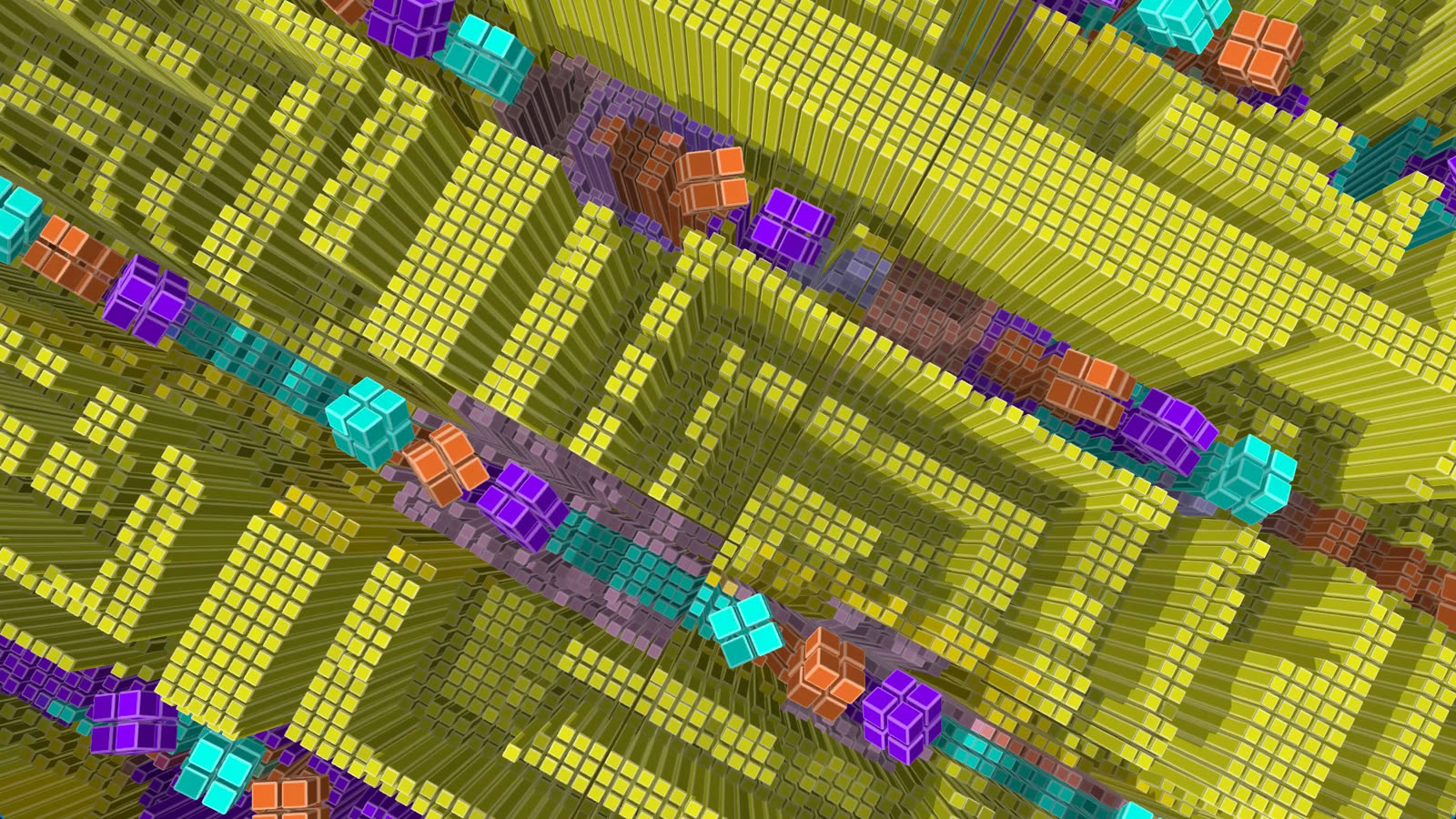
I am interested in complexity, the forming of groups and rhythm. I love hierarchies and complex systems that can be seen and understood from their abstract structure down to the detail. My computational thinking shapes my artistic work. For me, the relationships between individual elements, groups and overarching structures are a subject of positing in their own right.
The radicalism of minimal works fascinates me. I admire the consistency with which artists reduce and condense their work. I learn a great deal from it. For me, Concrete Art is essential to the clarity of a decision and to the concentration on a single positing.
I would particularly like to pay tribute to Jo Kuhn. At Hellweg Konkret III in the Westfälische Salzwelten, I was able to show my work in the context of his works and of paintings by K. G. Schmidt. Kuhn's concentration on colour and Schmidt's foldings fascinate me and have shaped me. These experiences also sharpen my eye for my own work, without my deriving from them a general obligation to reduce.
I myself am particularly interested in groups, rhythms and variants within structures. A single form, its belonging to a group and the relationship between several groups can all be at work at the same time. Repetitions, deviations and overlaps are part of this engagement. As a matter of principle, I do not want to reduce these relationships until only an isolated positing remains.
I have no problem letting a positing become hard to take in at a glance, or placing contradictions within a system. These are deliberate decisions. The frequent objection that a work asks too much of its viewers is therefore not, for me, a sufficient reason to simplify it. Part of my radicalism lies in continuing to work at the point that interests me myself. In doing so, I accept asking too much.
In my post-digital model of positing, I look at my work from the reference points of art informel, Concrete Art and representation. The additive context described there is essential to my engagement with complexity: through additional rules, gestures or relationships, what is already there changes. Meaning can open up through enrichment. Leaving things out is not the only way to get there.
Nor do I, as a matter of principle, hold myself back in my production or in trying out different worlds. Abundance gives rise to new creativity, new perspectives and new positings. I do not want to limit these possibilities in advance in order to commit my work throughout to a reduced formal language.
Digital and AI-assisted processes accelerate this experimentation considerably. Where the material execution of individual paintings alone takes months, variants can sometimes be played through in days. This change in the conditions of learning, and the possible acceleration of artistic condensation, should not be underestimated. The resulting diversity can look like too much, even though intensive engagement is already contained within it. This way of working brings different mental challenges with it.
Within a single artwork, I deliberately hold back when I want to bring out a positing and concurrent things would obscure it. There I limit, select and leave out. However, I do not transfer this decision for one work to my entire production. Several relationships, groups or contradictory rhythms can also be what I want to bring out in a work.
I condense out of reflection and conviction. Not throughout, and not everywhere. My appreciation for the consistency of minimal art and my interest in complex positings exist side by side. The complexity of my work is not an unconscious element. It belongs to what I consciously posit.
How to cite
Post, Tobias (2026): Complexity as Positing. https://cube4arts.com/documents/komplexitaet-als-setzung
Author
Tobias Post
Artist · Digital Light Art · Painting · Curatorial Projects
More documents
All documents-
Two separate halves grow together
Tobias Post — the story behind the art
Combining art and technology is my superpower for immersive art
-
Stance and school of thought
Post-Digital Model of Positing, after Tobias Post
Looking is itself a form of positing
-
A historical hypothesis on the new meaning of art
From Post-War Society to AI Society
How human competence is shifting
-
It is not only the work that gets standardised
The Mislabelling
but the entire social staging of being an artist